What Happens When Sport Innovation Leaders Get in a Room Together?
07/07/2026
Share this post

What Happens When Sport Innovation Leaders Get in a Room Together?
Monday, 29 June 2026 • New York City Eternal HQ
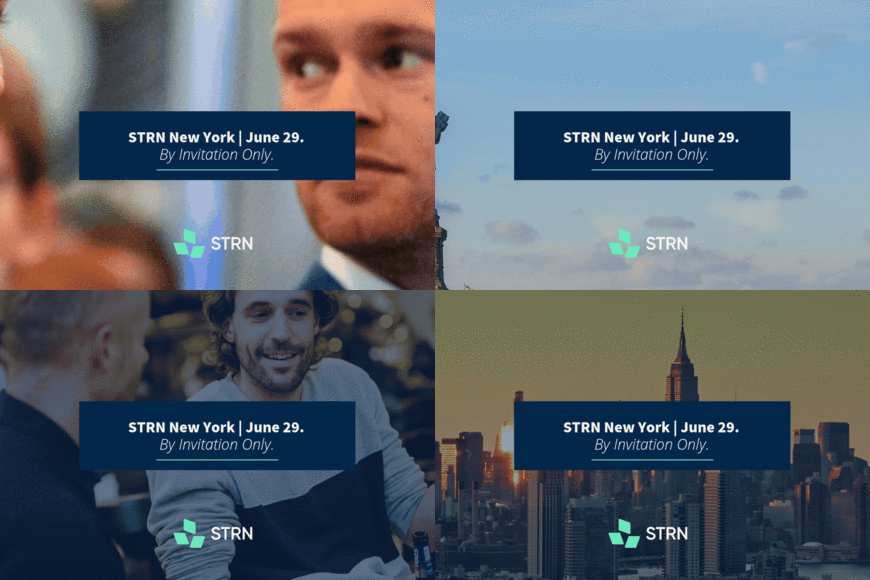
On June 29, 2026, more than 50 leaders from elite sport, academia, industry, and investment gathered in New York City for the STRN Sport Innovation Exchange — a day designed not around presentations, but around honest conversation.
The question driving the day was deceptively simple: How do we close the gap between innovation and real-world impact in sport?
Through an opening panel, lightning talks, collaborative roundtables, and participant-led problem-solving sessions, five ecosystem insights emerged — themes that reflect a maturing industry shifting its focus from building new tools to building better systems.
"Innovation is not simply about creating something new — it is about improving decisions, workflows, communication, and ultimately athlete outcomes."
— Recurring theme, STRN Sport Innovation Exchange 2026
Here is a preview of the five insights that shaped the day:
- Define the Problem Before the Solution
- Generate Evidence That Supports Decisions
- Build Organizations That Can Adopt Innovation
- Partnerships Accelerate Ecosystem Learning
- Credibility Is Built Through Transparency
Five Insights from the STRN Sport Innovation Exchange 2026
New York City • June 29, 2026
1. Define the Problem Before the Solution
Too often, organizations become excited about new technologies before identifying the decision they are trying to improve. Participants agreed that successful innovation starts by asking: What problem are we solving? Who will use this? What decision will it support?
Engaging coaches, practitioners, researchers, clinicians, athletes, and technology developers early ensures solutions are designed around real-world needs rather than assumptions. Innovation that begins with a clearly defined problem is more likely to generate meaningful value — and more likely to be adopted.
2. Generate Evidence That Supports Decisions
Validation is not a one-time milestone — it is a continuous process. Evidence requirements should align with a technology's intended use, level of risk, and practical application. Whether monitoring daily wellness or informing critical return-to-play decisions, the ecosystem needs proportional evidence frameworks that balance scientific rigor with practical feasibility.
Participants also emphasized the importance of communicating evidence clearly — including its limitations — to coaches, executives, and practitioners who may not have a research background.
3. Build Organizations That Can Adopt Innovation
A well-validated tool is only as good as the organization using it. Successful implementation requires more than a purchase order — it requires leadership, scientific literacy, workflow integration, and behavior change. Organizations must invest in implementation capability to ensure that new insights lead to actual shifts in practice and better outcomes for athletes.
Trust between practitioners, coaches, athletes, and technology developers was identified as a critical — and often underestimated — ingredient for successful adoption.
4. Partnerships Accelerate Ecosystem Learning
No single organization has all the answers. Effective collaboration between researchers, practitioners, technology companies, investors, and governing bodies creates a powerful feedback loop that accelerates learning across the ecosystem.
Participants described the best partnerships as built on curiosity, shared objectives, and complementary expertise — not just contractual agreements. Long-term relationships strengthen the ecosystem well beyond any individual project or product.
5. Credibility Is Built Through Transparency
Credibility is a shared ecosystem asset. It develops gradually through transparent communication, scientific rigor, independent evaluation, and consistent delivery of value. Organizations that openly communicate both the strengths and limitations of their technologies are consistently viewed as more trustworthy — and more likely to drive lasting adoption.
Every stakeholder — researchers, developers, practitioners, investors, and athletes — contributes to strengthening or weakening the trust that underpins innovation.
📄 Full Whitepaper Coming Soon
The insights from the Exchange are being expanded into a comprehensive STRN whitepaper, providing in-depth analysis and practical recommendations for researchers, practitioners, industry, investors, and governing bodies. Stay tuned — we look forward to sharing it with the STRN community shortly.
🎓 Academic Sponsor: Seton Hall University • 🥉 Bronze Sponsor: VALD • 🏢 Hosted by: Eternal
Comments
There are no comments yet.